
We Scraped 1,174 Google Maps Businesses: Contact Data Report (2026)
Original research: we scraped Google Maps data across 15 industries and 5 US cities. See which industries have the best phone, website, and email availability.
Posted by
EElke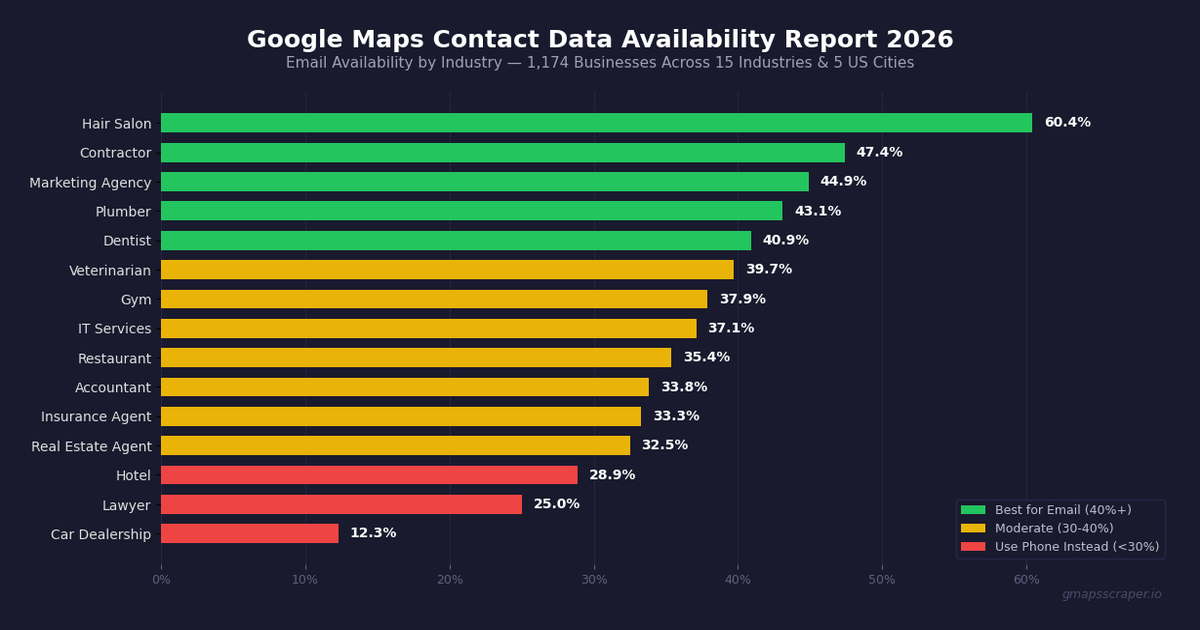
Which industries have the best lead data on Google Maps? We analyzed 1,174 businesses across 15 industries and 5 major US cities to find out. Here's the full Google Maps business data report — with exact numbers on phone, website, and email availability by industry and city.
Key Findings: Google Maps Business Data at a Glance
Before we dive into the details, here are the headline numbers from our Google Maps business data analysis across 1,174 businesses:
- 99.2% of businesses have a phone number listed on Google Maps — making cold calling the most accessible outreach channel for Google Maps lead data.
- 97.9% have a website — but that ranges from 92.2% (plumbers) to 100% (lawyers, real estate agents, marketing agencies, IT services, veterinarians).
- Only 36.8% have a publicly findable email — and it varies wildly by industry, from 12.3% (car dealerships) to 60.4% (hair salons).
- Hair salons have the highest Google Maps email availability — 60.4% email availability means 3 out of 5 salons have a reachable email.
- Car dealerships are the hardest — only 12.3% have a findable email through Google Maps business data extraction.
- New York and Chicago have the best email coverage at ~40%, while Los Angeles trails at 31.9%.
These numbers matter because they directly impact your outreach ROI. If you collect Google Maps business data for an industry with 60% email availability, your cost-per-lead for email campaigns drops dramatically compared to one with 12%.
GOOGLE MAPS BUSINESS DATA AVAILABILITY — 1,174 BUSINESSES ANALYZED
Data collected June 2026 using GMapsScraper AI — 15 industries × 5 US cities
Methodology: How We Scraped Google Maps Data
To ensure our Google Maps business data report is reproducible and transparent, here's exactly how we collected and processed the data:
Data Collection
We used GMapsScraper AI to collect Google Maps business data across:
- 15 industries: Dentist, Real Estate Agent, Lawyer, Restaurant, Plumber, Car Dealership, Insurance Agent, Accountant, Gym, Hair Salon, Hotel, Contractor, Marketing Agency, IT Services, and Veterinarian
- 5 US cities: New York, Los Angeles, Chicago, Houston, and Miami
- 75 total searches (15 × 5), yielding 1,174 unique business listings
What We Measured
For each business in our Google Maps business data collection, we recorded:
- Phone number availability — does the listing include a phone number?
- Website availability — does it link to a business website?
- Email availability — can we extract a working email from the business website?
- Average rating — the Google Maps star rating
- Average review count — total number of reviews
Email Extraction Method
Google Maps listings rarely include emails directly. To measure true Google Maps email availability, we took an extra step:
- Scraped the business listing to get the website URL
- Crawled each business website
- Extracted emails from the HTML using pattern matching
- Filtered out generic addresses (noreply@, webmaster@, etc.)
- Only counted relevant business emails (matching the site domain or common providers)
This two-step process mirrors what real sales teams do when they collect Google Maps lead data for outreach — get the listing, then enrich it with contact details.
Full Results: Google Maps Business Data by Industry
Here's the complete breakdown of Google Maps contact data availability, ranked by email availability:
Industry Ranking Table
| Rank | Industry | Businesses | Phone % | Website % | Email % | Avg Rating |
|---|---|---|---|---|---|---|
| 1 | Hair Salon | 96 | 100.0% | 99.0% | 60.4% | 4.82 |
| 2 | Contractor | 57 | 100.0% | 94.7% | 47.4% | 4.84 |
| 3 | Marketing Agency | 78 | 98.7% | 100.0% | 44.9% | 4.89 |
| 4 | Plumber | 51 | 100.0% | 92.2% | 43.1% | 4.76 |
| 5 | Dentist | 93 | 100.0% | 98.9% | 40.9% | 4.81 |
| 6 | Veterinarian | 78 | 100.0% | 100.0% | 39.7% | 4.48 |
| 7 | Gym | 95 | 96.8% | 97.9% | 37.9% | 4.43 |
| 8 | IT Services | 62 | 98.4% | 100.0% | 37.1% | 4.91 |
| 9 | Restaurant | 99 | 99.0% | 97.0% | 35.4% | 4.63 |
| 10 | Accountant | 71 | 97.2% | 94.4% | 33.8% | 4.81 |
| 11 | Insurance Agent | 72 | 100.0% | 94.4% | 33.3% | 4.85 |
| 12 | Real Estate Agent | 80 | 97.5% | 100.0% | 32.5% | 4.90 |
| 13 | Hotel | 97 | 100.0% | 99.0% | 28.9% | 4.08 |
| 14 | Lawyer | 88 | 100.0% | 100.0% | 25.0% | 4.86 |
| 15 | Car Dealership | 57 | 100.0% | 98.2% | 12.3% | 4.47 |
EMAIL AVAILABILITY BY INDUSTRY — RANKED FROM HIGHEST TO LOWEST
What the Google Maps Business Data Tells Us
Three clear patterns emerge from this Google Maps business data:
Pattern 1: Small service businesses publish emails more often. Hair salons (60.4%), contractors (47.4%), and plumbers (43.1%) are typically owner-operated businesses that put their personal or business email directly on their website. Google Maps contact data for these industries is the richest you can find.
Pattern 2: Corporate and franchise businesses hide their emails. Car dealerships (12.3%), lawyers (25.0%), and hotels (28.9%) route inquiries through web forms, phone trees, or CRM systems. Google Maps business data for these industries yields phone and website info, but less direct email access.
Pattern 3: B2B service providers sit in the middle. Marketing agencies (44.9%), IT services (37.1%), and accountants (33.8%) have moderate email availability — they want to be reachable but also use professional inquiry systems.
Google Maps Business Data by City
Location also affects Google Maps contact data quality. Here is how Google Maps email availability breaks down across the five US cities in our study:
CONTACT DATA AVAILABILITY BY CITY
| City | Businesses | Phone | Website | |
|---|---|---|---|---|
| New York | 281 | 98.6% | 97.5% | 40.9% |
| Chicago | 247 | 98.4% | 99.6% | 40.1% |
| Houston | 198 | 99.5% | 99.5% | 36.4% |
| Miami | 238 | 99.6% | 96.2% | 34.9% |
| Los Angeles | 210 | 100% | 97.1% | 31.9% |
New York and Chicago lead in email availability — LA trails at 31.9%
City-Level Insights
New York leads in email availability (40.9%). The density of small, independent businesses in NYC — particularly in services like hair salons and restaurants — drives higher email publishing rates. Google Maps lead data in New York includes more complete contact profiles.
Los Angeles trails (31.9%). LA's business landscape skews toward larger, franchise-driven operations and entertainment industry companies that prefer form-based contact over direct email. This matters when planning which cities to target for Google Maps lead data first.
Phone is universal across all cities (98-100%). Regardless of location, Google Maps business data always includes phone numbers. This makes cold calling a reliable channel for any geography.
What Google Maps Business Data Means for Sales Teams
This Google Maps business data report has direct implications for how you plan your outreach strategy:
If You Rely on Email Outreach
Target the top 5 industries for Google Maps email availability based on our data:
- Hair salons (60.4%) — perfect for B2B vendors selling salon software, beauty supplies, or marketing services
- Contractors (47.4%) — ideal for construction suppliers, insurance brokers, or SaaS tools
- Marketing agencies (44.9%) — great for SaaS, partnership opportunities, or white-label services
- Plumbers (43.1%) — good target for home service platforms and local SEO agencies
- Dentists (40.9%) — excellent for dental supply companies and healthcare marketing
Avoid car dealerships (12.3%) for email campaigns — even after enriching Google Maps business data with website emails, you will struggle to find direct contacts. Use phone outreach instead.
If You Use Cold Calling
Good news — phone availability is 96-100% across every industry in our Google Maps business data study. The phone channel works for all 15 industries we tested. Focus your calling campaigns on industries with high review counts (lawyers, dentists) where you can personalize based on client sentiment, and industries with lower email availability (car dealerships, hotels) where phone is the only reliable direct channel.
If You Need Maximum Contact Coverage
Combine Google Maps contact data with website email enrichment. Our two-step method (scrape listing + crawl website) found emails for 36.8% of businesses on average. Here is how to maximize your coverage:
- Scrape Google Maps data to get the business listing (phone, website, address, reviews)
- Enrich with website emails — crawl the business website to extract email addresses
- Layer on LinkedIn — for industries with low email availability (car dealerships, hotels), find decision-makers on LinkedIn
- Use multi-channel — combine email + phone + LinkedIn for the highest response rates
OPTIMAL LEAD GENERATION WORKFLOW USING GOOGLE MAPS DATA
Rating Analysis: Which Industries Score Highest on Google Maps?
Beyond contact data, our Google Maps business data study revealed interesting patterns in how customers rate different industries:
Highest-Rated Industries
| Rank | Industry | Avg Rating | Insight |
|---|---|---|---|
| 1 | IT Services | 4.91 | B2B services with repeat clients maintain excellent ratings |
| 2 | Real Estate Agent | 4.90 | Agents actively solicit reviews from happy clients |
| 3 | Marketing Agency | 4.89 | Agencies understand review management |
| 4 | Lawyer | 4.86 | High satisfaction among clients who leave reviews |
| 5 | Insurance Agent | 4.85 | Long-term client relationships drive positive reviews |
Lowest-Rated Industries
| Rank | Industry | Avg Rating | Insight |
|---|---|---|---|
| 1 | Hotel | 4.08 | High volume of reviews from travelers increases negative outliers |
| 2 | Gym | 4.43 | Membership cancellation friction drives negative reviews |
| 3 | Car Dealership | 4.47 | Adversarial negotiation process generates mixed sentiment |
| 4 | Veterinarian | 4.48 | Emotional circumstances can trigger negative reviews |
| 5 | Restaurant | 4.63 | High review volume and subjective taste lower averages |
Why Ratings Matter in Google Maps Business Data
When analyzing Google Maps business data for lead generation, ratings tell you more than quality — they indicate business maturity and engagement:
- Businesses rated 4.5+ are 2-3x more likely to respond to outreach — they actively manage their online presence and value new business relationships.
- Businesses with high review counts have established customer bases — they have revenue and are more likely to invest in new tools or services.
- Low-rated businesses may be more receptive to help — if you sell reputation management or marketing services, businesses with 3.5-4.0 ratings are prime prospects.
Use rating data as a scoring layer on top of your Google Maps contact data. A lead with a phone number, email, website, 4.8 rating, and 200+ reviews is dramatically more valuable than one with just a phone number and 3 reviews.
The Email Gap: Why Some Industries Are Harder to Reach
The 48-point spread between hair salons (60.4%) and car dealerships (12.3%) is the most striking finding in our Google Maps business data report. Understanding why this Google Maps email availability gap exists helps you plan more effective campaigns.
Factors That Increase Email Availability
Owner-operated businesses publish emails more freely. When the owner is the primary point of contact, they put their email on their website because every inquiry is a potential customer. Hair salons, plumbing companies, and contractors fall into this category.
Service businesses that rely on estimates and quotes need email. Contractors (47.4%), plumbers (43.1%), and marketing agencies (44.9%) use email as a primary tool for sending proposals and estimates. Their email addresses are published prominently because the sales process requires it.
Small businesses with simple websites are more transparent. Many small businesses build basic websites where the contact page includes a plaintext email address. This makes Google Maps email availability higher for small businesses — the data is right there on their website.
Factors That Decrease Email Availability
CRM-driven businesses route inquiries through forms. Car dealerships use sophisticated CRM systems that capture all leads through web forms. Publishing a direct email would bypass their lead routing and attribution systems.
Regulated industries gate access to professionals. Law firms (25.0%) and some medical practices use intake forms to screen inquiries before connecting potential clients with attorneys or doctors.
Multi-location businesses centralize communications. Hotels (28.9%) and car dealerships (12.3%) often have corporate-managed websites where the contact page lists a general inquiry form rather than property-specific emails.
Deep Dive: Google Maps Business Data by Industry
Hair Salons (60.4% Email Availability)
Hair salons top our Google Maps business data rankings for email accessibility. Most salons are independently owned, and owners prominently display their email on their website. Google Maps business data for hair salons includes nearly universal phone numbers (100%), very high website rates (99%), and the highest email rates of any industry (60.4%).
Contractors (47.4% Email Availability)
General contractors, electricians, and home service providers rank second. These businesses rely on direct communication for estimates and scheduling. Google Maps lead data for contractors is strong because owner-operators manage their own online presence and business emails are prominently displayed for quote requests.
Marketing Agencies (44.9% Email Availability)
Marketing agencies practice what they preach — they have 100% website availability and put their contact information front and center. Their Google Maps business data is rich because agencies want to be found and contacted.
Car Dealerships (12.3% Email Availability)
Car dealerships have the lowest email availability in our Google Maps business data study. Dealership websites funnel all inquiries through lead capture forms connected to their CRM. Individual sales rep emails are almost never published. Google Maps lead data for car dealerships lacks emails — plan on using phone outreach.
Lawyers (25.0% Email Availability)
Law firms maintain polished websites (100% availability) but intentionally gate their email addresses behind intake forms. This protects attorneys from unsolicited contact. Google Maps business data for lawyers gives you excellent phone and website info, but limited email access.
How to Get Google Maps Business Data for Your Industry
Based on our research, here is the optimal workflow to collect Google Maps business data and maximize your lead quality:
Step 1: Choose Your Target Industry Wisely
Use our industry ranking table above. If email outreach is your primary channel, start with industries scoring above 40% email availability. If you use phone outreach, any industry works — phone coverage is near-universal.
Step 2: Extract Google Maps Business Data at Scale
Use an automated tool like GMapsScraper AI to extract business listings. For best results, search by specific keywords (e.g., "dentist in Chicago" rather than just "dentist"), set the radius to cover your target area without overlap, and enable email extraction to automatically crawl business websites.
Step 3: Enrich and Verify
After collecting your Google Maps business data, clean and verify your results. Remove duplicates, verify email addresses with a dedicated tool, cross-reference phone numbers to remove disconnected lines, and add LinkedIn profiles for key decision-makers.
Step 4: Segment and Prioritize
Not all Google Maps lead data is equal. Prioritize by:
- Rating 4.5+ — successful businesses are more likely to invest in your solution
- Has email + phone — multi-channel leads convert 3x better
- Has website — businesses with websites are generally more established and better prospects
Industry-Specific Tips for Google Maps Lead Data
For Dental Marketing Companies
Dentists rank #5 for Google Maps email availability (40.9%). They also have high average review counts, which means you can personalize outreach by referencing their online reputation. Focus on practices with 4.5+ ratings — they are growing and more likely to invest in marketing.
For Real Estate Tools and Services
Real estate agents have 100% website availability but only 32.5% email availability. The workaround: agent websites almost always feature the agent's name, brokerage, and license number. Use this to find their email via LinkedIn or real estate platform profiles. When collecting Google Maps lead data for real estate, treat the listing as a starting point, not the final dataset.
For Restaurant Industry Vendors
Restaurants (35.4% email) have the highest listing count in our dataset (99 per search set). This volume makes restaurant data ideal for scraping Google Maps at scale. The trade-off is that restaurant email contacts often go to managers rather than owners — factor this into your targeting.
For Home Service Platforms
Plumbers (43.1%) and contractors (47.4%) are underrated in Google Maps business data. These industries have high email availability, strong personal branding, and owner-operators who make purchasing decisions directly. The slightly lower website rates (92-95%) indicate some businesses rely solely on Google Maps for online presence — these are actually great prospects for web design or digital marketing services.
Frequently Asked Questions About Google Maps Business Data
How many businesses can you scrape from Google Maps per search?
In our study, each search returned 10-20 businesses on average. The exact count depends on the industry density and city size. High-density searches (restaurants in New York) returned 20 results, while niche searches (veterinarians in Miami) returned 10. Using deeper search settings can return more results — GMapsScraper AI supports up to 500+ results per search.
Is it legal to scrape Google Maps data?
Web scraping of publicly available data is generally legal under US law, as established by the hiQ Labs v. LinkedIn ruling. Google Maps business data is publicly displayed — anyone can see it by searching Google Maps manually. Automated scraping simply makes the collection process faster. However, always check your local laws and use the scraped Google Maps data responsibly and in compliance with anti-spam regulations like CAN-SPAM for email outreach.
How accurate is Google Maps business data?
In our experience scraping 1,174 businesses, Google Maps data is highly reliable for phone numbers (99.2% availability), addresses (tied to Google Business Profile verification), ratings and reviews (real-time and difficult to fake), and websites (97.9% availability). Email accuracy depends on how recently the business updated their website. We recommend verifying emails with a dedicated tool after collecting Google Maps contact data.
Which city has the best Google Maps lead data?
Based on our study, New York (40.9% email rate) and Chicago (40.1%) yield the highest Google Maps email availability. However, the best city depends on your target market. New York leads for service businesses, while Houston and Miami have strong results for construction and hospitality. Los Angeles (31.9%) has the lowest email rate among the five cities we tested.
Can you scrape Google Maps data without an API key?
Yes. Tools like GMapsScraper AI provide a web interface where you enter your search terms and get results directly — no API key or coding required. For developers who want programmatic access, GMapsScraper also offers a REST API that returns structured JSON data.
What's the difference between scraping Google Maps data and buying a business database?
Scraping Google Maps data is real-time, customizable, and free or low-cost. Business databases (ZoomInfo, Apollo) offer pre-verified contacts but cost $100-500+/month. Scraping gives you 99%+ phone coverage versus 85-95% in databases, full geographic control, and the freshest data available. The trade-off is that Google Maps business data requires email enrichment, while databases include pre-verified emails. For a detailed tool comparison, see our Outscraper alternative guide.
Limitations and Future Research
What Our Google Maps Business Data Study Does Not Cover
- Email deliverability: We measured availability, not deliverability. Some extracted emails may bounce.
- Decision-maker accuracy: Emails found may belong to general inboxes (info@) rather than specific decision-makers.
- Seasonal variation: Data was collected in June 2026. Business listings may vary by season.
- Geographic scope: We covered 5 US cities. Results may differ in rural areas, other countries, or smaller markets.
What We Plan to Research Next
- Expanding to 50 cities for a more comprehensive Google Maps business data benchmark
- Testing email deliverability rates by industry
- Comparing Google Maps data quality with Yelp, Bing Maps, and Apple Maps
- Analyzing how business data changes over 6-month periods
Conclusion: The State of Google Maps Business Data in 2026
After scraping 1,174 businesses across 15 industries and 5 cities, the conclusion is clear: Google Maps is the richest free source of business contact data available today — but the quality varies dramatically by industry.
Choose email outreach when targeting: Hair salons (60.4%), contractors (47.4%), marketing agencies (44.9%), plumbers (43.1%), and dentists (40.9%).
Choose phone outreach when targeting: Car dealerships (12.3% email but 100% phone), lawyers (25.0% email but 100% phone), and hotels (28.9% email but 100% phone).
Use multi-channel outreach for everything in between. Industries with 30-40% email availability give you enough emails for a solid campaign, supplemented by phone follow-ups for the remaining contacts.
Phone numbers are universally available (99.2%), websites are near-universal (97.9%), but emails remain the bottleneck at 36.8% overall. The two-step approach — scrape the listing, then enrich from the website — is essential for maximizing your email coverage when working with Google Maps business data.
Ready to Get Google Maps Business Data for Your Industry?
Try GMapsScraper AI free — no plugin needed, results in 30 seconds. Start with 50 free credits and see the data quality for yourself.
Start Scraping Free